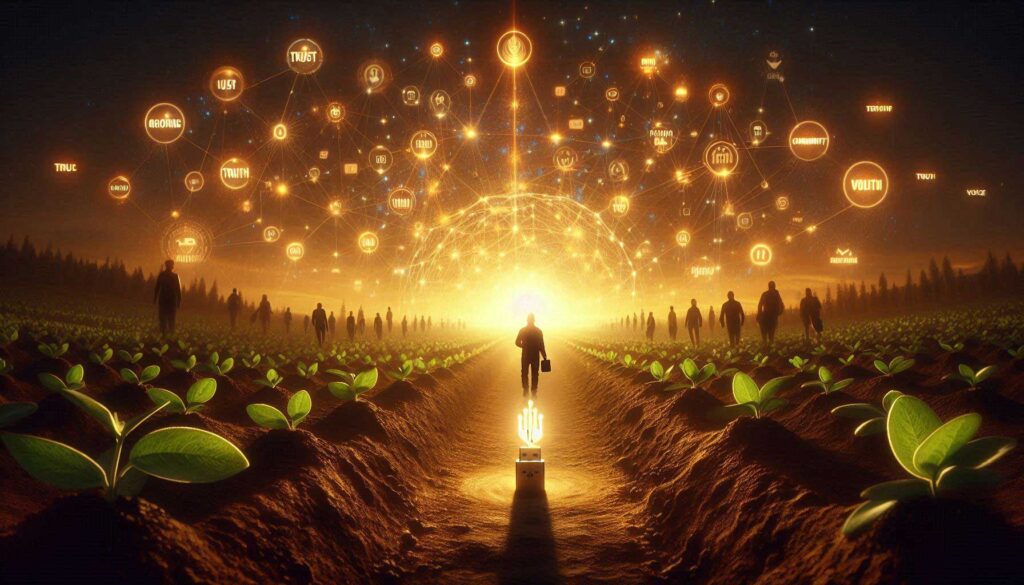
Promises Made, Promises Broken
What the Internet Was Supposed to Be — and What It Became
When the internet was born, it carried the hopes of an entire generation of engineers, visionaries, and idealists.
“We are in the middle of the most transforming event since the capture of fire.”
— John Perry Barlow, Co-founder, Electronic Frontier Foundation (1994)
It was going to be the great equalizer — a tool for global understanding, free expression, and boundless opportunity. The original pioneers didn’t just believe the internet could change the world — they believed it could change it for good.
But somewhere along the way, something changed.
The Promise: Equal Opportunity and Open Markets
Al Gore, an early champion of internet expansion, described it as a global marketplace for ideas and entrepreneurship.
“A place where innovation thrives and opportunity is democratized.”
The Reality: Monopolies and consolidation.
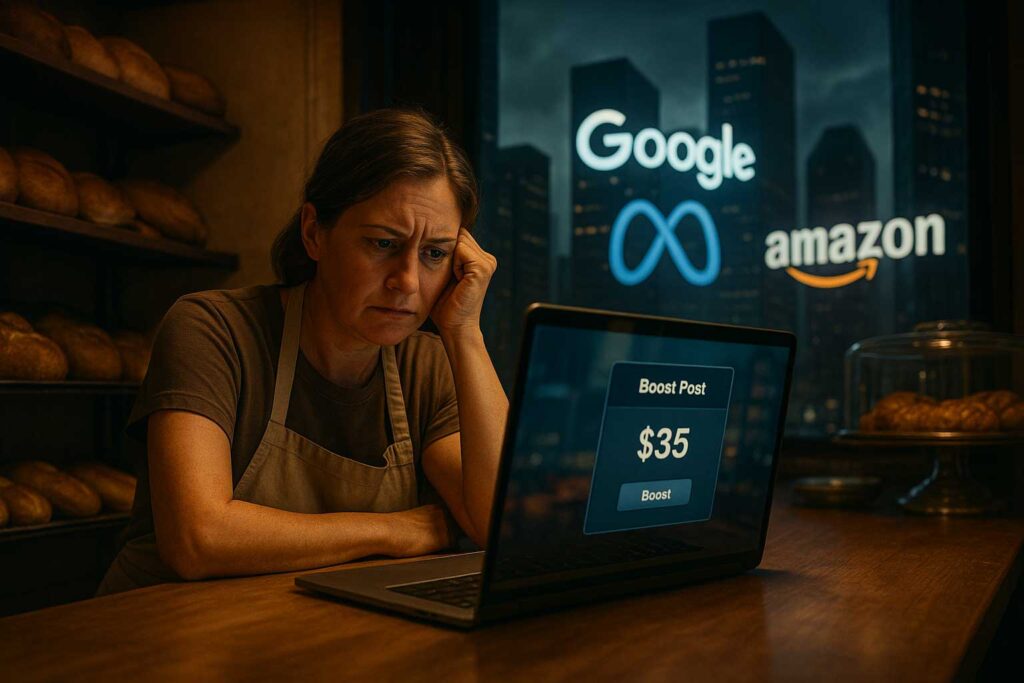
As of 2024, over 70% of all internet advertising revenue flows to just three companies: Google (Alphabet), Meta (Facebook/Instagram), and Amazon.
Real-World Impact:
A local bakery creates a video that goes viral in their town — but unless they pay to “boost” it, only a tiny fraction of their followers ever see it.
A new online newspaper breaks a local corruption story — but can’t compete with corporate ad budgets for visibility in search results.
Independent creators on YouTube build a following, only to be demonetized overnight with no explanation — cutting off their income stream.
The rest of the internet — small businesses, nonprofits, independent voices — are left building their future on rented ground, governed by opaque algorithms.
The Promise: Universal Access to Knowledge
Tim Berners-Lee, inventor of the World Wide Web, envisioned a decentralized system where anyone, anywhere, could share and discover information.
“The Web is more a social creation than a technical one… a collaborative space.”
The Reality: Paywalls, distraction, and misinformation.
Search results are auctioned. Headlines are engineered for clicks, not clarity. And meaningful insight is often hidden behind expensive subscriptions.
Real-World Impact:
A parent trying to research vaccine safety is flooded with conflicting sources — many designed to mislead.
A student can’t access the scholarly journal article they need without a $40 payment.
Local news about zoning, elections, or school board decisions is increasingly inaccessible as small papers die off.
Instead of empowering citizens with truth, the web often overwhelms them with noise — or walls them off from credible sources.
The Promise: Free Speech and Global Voice
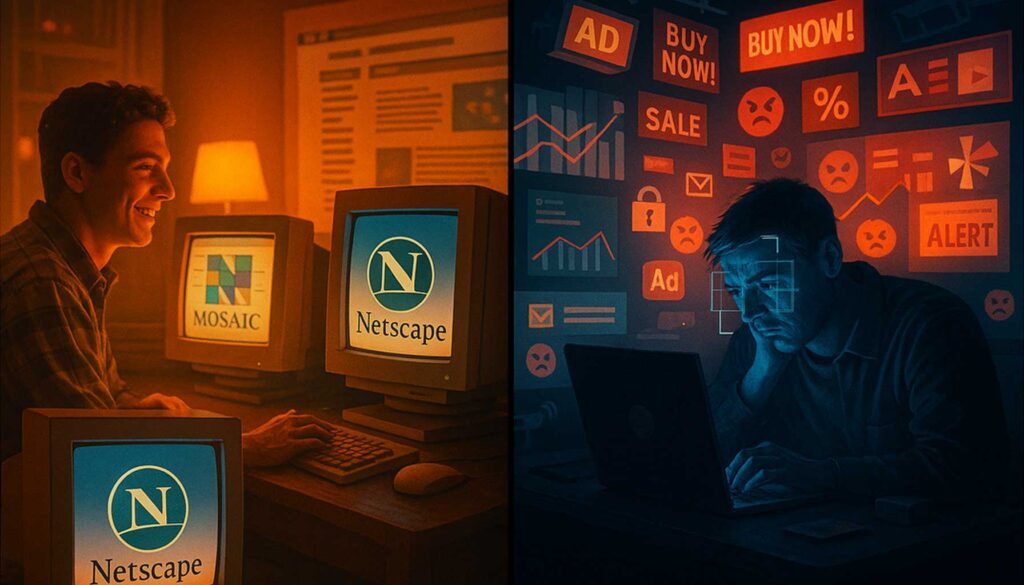
Marc Andreessen, co-creator of the first mainstream web browser (Mosaic), and later Netscape, called the internet “a new platform for expression and commerce.”
“You can publish anything, instantly — and reach the world.”
It was a powerful promise — and a half-truth.
Yes, anyone can publish. But who will listen?
The Reality: Rage algorithms and shadow bans.
Voices are amplified or suppressed based not on value, but on their ability to spark engagement — especially negative engagement.
Real-World Impact:
A thoughtful podcast on community healing gets buried in feeds, while outrage-fueled clips rise to the top.
A faith-based nonprofit has their posts throttled for violating vague “misinformation” policies.
A veteran shares a deeply personal post — and gets harassed by bots for days while reporting tools offer no help.
The democratization of voice has been replaced by a contest of volume and volatility.
The Promise: Privacy and Data Ownership
Vinton Cerf, one of the “fathers of the internet,” advocated for a design where users controlled their digital identities.
“Users should control their own data and identity.”
The Reality: Surveillance capitalism.
Your every click, scroll, and pause is tracked — not just to “improve your experience,” but to feed massive data engines that sell your attention to the highest bidder.
Real-World Impact:
A teenager researching eating disorders is targeted with harmful weight loss ads.
A couple looking for a home is bombarded with real estate promotions — before they’ve told a soul.
A person visits one job site and starts getting job-related spam across unrelated platforms.
Your data is not just collected — it’s monetized without your control or knowledge.
The Promise: Human-Centered Community
Visionaries like Esther Dyson and Nicholas Negroponte imagined the internet as a kind of global town square — a digital commons for connection and shared learning.
“The Internet is about community, not isolation. It’s about giving everyone a voice, not just a few broadcasters. It should be a place where people build relationships, solve problems, and find common ground.”
— Esther Dyson, Release 2.0 (1997)
The Reality: Isolation, manipulation, and digital fatigue.
Social feeds are engineered to maximize scrolling, not meaning. Interactions are reduced to likes and dopamine loops.
Real-World Impact:
A new mother searches for truth about a new vaccine but finds herself drowning in filtered perfection and algorithm-fed “news”.
A teenager feels “connected” 24/7, yet admits they’ve never felt more alone.
A retiree joins social media to connect with grandkids — but ends up trapped in divisive content he never searched for.
What was meant to unite us often fragments us.
What was meant to humanize now commodifies.
So What Went Wrong?
The internet didn’t collapse. It was captured.
Captured by business models that thrive on distraction and division.
Captured by algorithms that reward outrage over insight.
Captured by corporations that promised freedom, but delivered control.
The Good News? It’s Not Too Late.
We don’t need to tear down the internet. We need to restore what was lost — and rebuild what was stolen.
That’s what Opedians do, they reclaim the original dream — not with slogans, but with systems.
Opedians Rebuild.
And here’s how.
Using Chronicles Publishing System (CPS) tools, we’ve built a network of over 100 community-powered, purpose-driven Opedia sites — where countless Opedians can reclaim their voice and help restore what the internet once promised.
This isn’t theory. It’s infrastructure.
Local ownership: Each Opedia site is designed to be stewarded by local voices who understand the heartbeat of their community — from Autosopedia to Faithopedia to WorldSportsopedia.
Shared visibility: The publishing system empowers contributors to be seen — without relying on algorithms designed to bury them.
Data integrity: We don’t sell user data. We don’t harvest behavior. Every user and contributor knows where their content lives — and why.
Opportunity at scale: Through Chronicles 100 Corp, small-town creators, faith-based leaders, subject-matter experts, and local entrepreneurs gain access to shared tools, monetization, and national reach — while keeping control.
Resilient publishing: Whether it’s news, stories, recipes, commentary, or music — voices that would otherwise be overlooked now have a home.
Opedia is not just a name. It’s a new way forward.
A return to what was promised.
A chance to build something better — together.
Because when something worth loving is broken, you don’t walk away.
You rebuild. With purpose. With people. With Opedias.
Ready to Help Rebuild What Was Broken?
You don’t need to be a tech founder to reclaim the promise of the internet.
You just need to care — and take one step.
Your support trains the first 50 Chronicles Publishers.
Your gift gives voice back to the people.